

Perfusion for next generation biosimilars
Perfusion is here, and it is rewriting the rules of biologics and biosimilar manufacturing. What was once experimental has become industrial reality: scalable, robust, regulatorily accepted, and commercially proven. As global demand for high quality, cost competitive biosimilars accelerates, perfusion stands ready as the technology built for this moment.
For years, “N Reactor” full perfusion was viewed as an intriguing but demanding technology – admired for its potential yet approached cautiously. Concerns persisted around scalability, operational robustness, and regulatory acceptance. Today, those questions have been answered. Advances in cell retention systems, single use technologies, automation, and process analytics have transformed perfusion into a reliable, commercially viable platform. Successful GMP campaigns across the industry show that perfusion can deliver consistent performance at scale, with quality attributes aligned to regulatory expectations.
Meeting the critical challenges
Biosimilars stand to benefit most from this transformation. Their commercial reality is defined by intense price pressure, narrow margins, and the need to deliver originator level quality at significantly lower cost. Developers must achieve high productivity, stable CQAs, and predictable supply while operating within constrained budgets and competitive timelines. Perfusion directly addresses these constraints: it reduces COGs per gram, compresses seed trains, stabilizes product quality, and enables commercial output from smaller reactors. For biosimilars, perfusion is not simply an alternative manufacturing mode – it is a strategic lever for long term competitiveness.
Regulators have modernized frameworks to support intensified and continuous manufacturing. ICH Q13 provides harmonized guidance on continuous and hybrid processes, including explicit recognition of time, volume, and mass based batch definitions. For perfusion, this removes ambiguity around how batches should be defined and justified. With ICH Q13, manufacturers can confidently establish batch boundaries aligned to process design – whether based on cumulative harvest volume, defined duration, or total mass – while maintaining full regulatory compliance.
Next wave of biosimilars
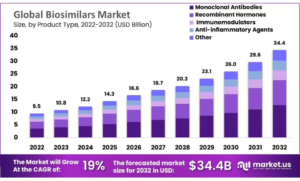
The broader market context reinforces this shift. Biosimilars are entering a decisive acceleration phase. Analysts forecast that the global biosimilars market will grow at a solid double digit pace through 2036, driven by patent expiries, payer pressure, and expansion into oncology, immunology, ophthalmology, and rare diseases. Europe remains the most mature market, but the steepest growth curves are expected in the United States and emerging regions. As biologics pipelines diversify and biosimilar competition intensifies, manufacturing models must evolve. Perfusion enables that evolution.
The 2026 BioPlan Annual Report captures this transition clearly: 42% of survey respondents stated they will be evaluating upstream continuous processing and perfusion at their facilities this year. This reflects a structural pivot toward technologies that deliver higher productivity, greater flexibility and lower cost. Samanta Cimitan, CEO of the Celonic Group, sees this shift as both inevitable and overdue. “The economics of biologics and biosimilars have fundamentally changed. Perfusion-based manufacturing is moving from a technical option to an essential strategic capability!”
Perfusion boosts productivity
Perfusion unlocks capabilities that directly address modern biologics and biosimilar constraints. High density cell culture enables dramatically higher volumetric productivity, allowing commercial output from 1,000 L–2,000 L single use reactors rather than 10,000 L fed batch systems. Continuous media exchange stabilizes product quality and reduces variability – critical for biosimilar comparability. Compressed seed trains free up facility time and reduce labor intensity. Smaller bioreactors reduce CAPEX and allow CDMOs to support multiple programs without expanding footprint. Perfusion aligns cost, quality, and scalability in a way fed batch cannot.
Supported by automation
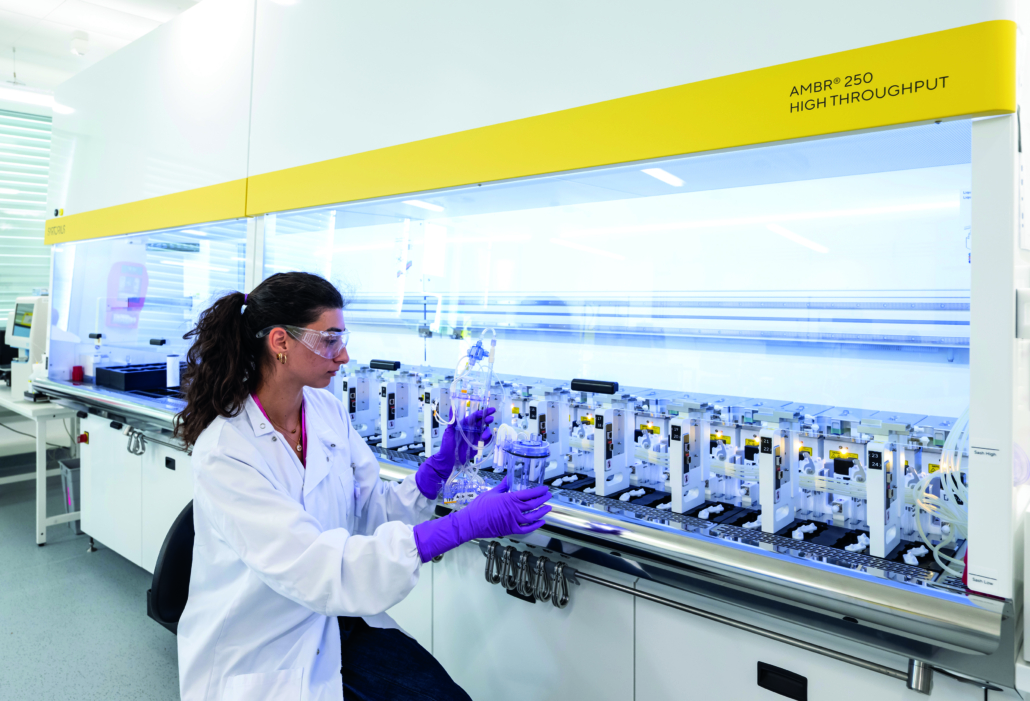
A major enabler of modern perfusion development is high throughput perfusion screening, now possible with the latest generation Sartorius Ambr® 250 HT 24 bioreactor system. This platform allows developers to evaluate dozens of clones, media strategies, and perfusion rate profiles in parallel under true perfusion conditions. For innovators, it compresses development timelines, increases data richness, and ensures that only the most robust candidates advance into pilot and GMP scale. For CDMOs like Celonic, it strengthens process predictability and reduces scale up risk – critical advantages in competitive biosimilar and biologics programs.
Equally important is the ability to scale perfusion reliably to commercial volumes. Modern single use systems such as the Cytiva Xcellerex™ X platform bioreactors have addressed historical concerns around perfusion scalability, particularly oxygen transfer at large volume. The latest X platform designs deliver significantly higher oxygen transfer capacity, enabling stable perfusion operation up to 2,000 L. With robust mass transfer performance, consistent mixing, and proven integration with ATF based cell retention systems, Cytiva bioreactors make high density perfusion not only feasible but reliable at commercial scale. Perfusion is compatible with modern control strategies, including enhanced PAT, automated perfusion rate algorithms, and predictive culture management.
From niche to new standard
Celonic recognized perfusion’s potential long before it entered mainstream biomanufacturing conversations. The company made early strategic investments in perfusion technologies, process intensification, and the operational capabilities required to run high density cultures reliably. These investments now position Celonic as one of the few CDMOs with true industrial perfusion expertise. Celonic offers not only access to perfusion technology, but also the accumulated process knowledge, operational discipline, and development to GMP integration required to implement it successfully.
Celonic is not alone in recognizing the strategic value of perfusion. Leading biosimilar and biologics manufacturers – including giants like Sandoz – are actively evaluating or implementing intensified upstream strategies to reduce COGs per gram and increase facility agility. Sandoz’s 2024 acquisition of Evotec’s biologics manufacturing site publicly underscored this trend, adding state of the art capacity with perfusion ready and intensified upstream capabilities. As biologics pipelines expand and biosimilar competition intensifies, perfusion is becoming a central pillar of next generation manufacturing strategies.
Expertise to rely on
Perfusion is no longer a niche technology. It is a commercially proven, regulatorily accepted, economically compelling manufacturing platform that aligns with the next decade of biologics and biosimilar growth. For biotech innovators and biosimilar developers, perfusion offers a way to scale smarter, move faster, and compete more effectively. Cimitan frames Celonic’s commitment clearly: “Biosimilars and next generation biologics deserve modern manufacturing. Perfusion is the technology that finally aligns cost, quality, and scalability. At Celonic, we’re committed to making intensified bioprocessing the new standard for our industry.”
Contact us:
Celonic AG, www.celonic.com
elisa.witt@celonic.com
This article is sponsored by Celonic.
 Polpharma Biologics SA
 Sandoz
 market.us