

NVision visualizes metabolics at work and expands to the Cambridge Innovation Cluster
Quantum computers? While most people have heard that their massively parallel data processing could open up an entirely new dimension of information technology, tangible real-world examples remain scarce. NVision Imaging Technologies in Ulm has been active in the field for years and has now developed a visible and practical innovation in metabolic imaging: real-time MRI. Leading academic institutions have already expressed strong interest.
How quantum computing technology and biomedical research can intersect has been explored for more than a decade by NVision, which was spun out of the University of Ulm in 2015. The company has now established its first strategic research hub at the University of Cambridge, within the Department of Radiology, in response to growing scientific demand. There, its quantum-based POLARIS platform will be installed to support research in oncology as well as neurodegenerative and cardiovascular diseases.
Making metabolism visible – observing molecules at work
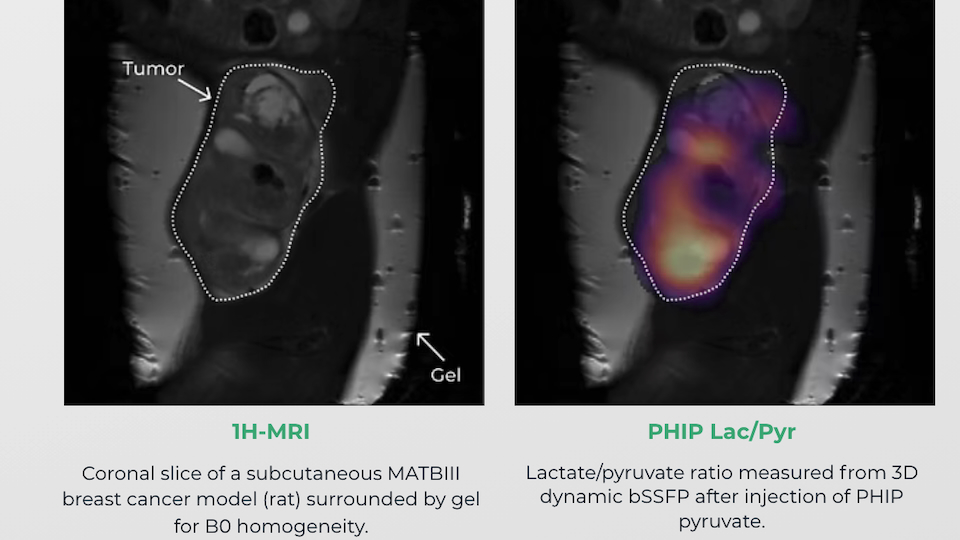
POLARIS amplifies the MRI signal of sugar molecules by more than 10,000-fold, enabling real-time visualisation of cellular metabolism. The technology could play a key role in developing metabolic biomarkers, accelerating treatment decisions and making drug discovery more efficient. The partnership aims to systematically translate metabolic imaging into clinical practice.
Following collaboration with the Memorial Sloan Kettering Cancer Center in the United States, Cambridge is set to become Europe’s long-term centre for “quantum-enhanced metabolic MRI”. For NVision, this marks a significant step in strengthening its international presence and positioning itself at the interface between quantum physics and medical imaging. The Cambridge hub is intended to drive innovative solutions to major medical challenges and ultimately improve patient outcomes.
A concrete link between quantum computing and pharmaceutical research
NVision relies on a novel quantum-based approach to make metabolic processes visible in real time — without requiring major modifications to existing MRI systems. At the core of the technology lies hyperpolarisation: using hyperpolarised hydrogen, metabolic intermediates such as pyruvate are transformed into highly sensitive “super-markers”. The polarised pyruvate, which is safe for the body, is injected prior to the MRI scan. By selectively aligning nuclear spins, MRI signals are dramatically amplified, allowing molecular metabolic processes to be visualised directly within tissue.
The roots of the technology date back to 2012, when the team around co-founder Professor Martin Plenio was researching nuclear spin-based quantum computers on diamond surfaces. The polarisation method developed there was later applied to liquids with the aim of enhancing MRI signals. Together with Professor Fedor Jelezko, also a co-founder, this led to the concept behind NVision.
Funding and venture capital
Financially, the development was supported by Plenio’s Alexander von Humboldt Professorship, two ERC Synergy Grants (“BioQ” and “HyperQ”), and additional EU funding, including for the “Hyperdiamond” project which helped advance the company’s formation. NVision also secured venture capital from investors in the United States and Germany. The University of Ulm supported licensing and patenting activities and provided infrastructure.
Dr Sella Brosh became CEO in 2017. The company now employs around 150 people – which is doubling the headcount in the last two years – and moved into a new building in Science Park III in Ulm in 2023. That same year, NVision completed an international financing round of around US$30 million, primarily from investors with a quantum computing background rather than traditional pharma venture capital.
Operationally, NVision is expanding the rollout of its technology. Hyperpolarisers have initially been delivered for preclinical small-animal research. A second product line for human applications has now been launched. Key markets include North America, Europe and the Asia-Pacific region — with a clear commitment to Ulm as the birthplace of the technology.
 BioNTech
 Unsplash+
 Unsplash+