€ 23 Mio: Afyren successful in capital increase
French Afyren secures €23m to accelerate biorefinery expansion as first plant enters full industrial ramp-up. Most of the money comes from US company Kemin Industries.
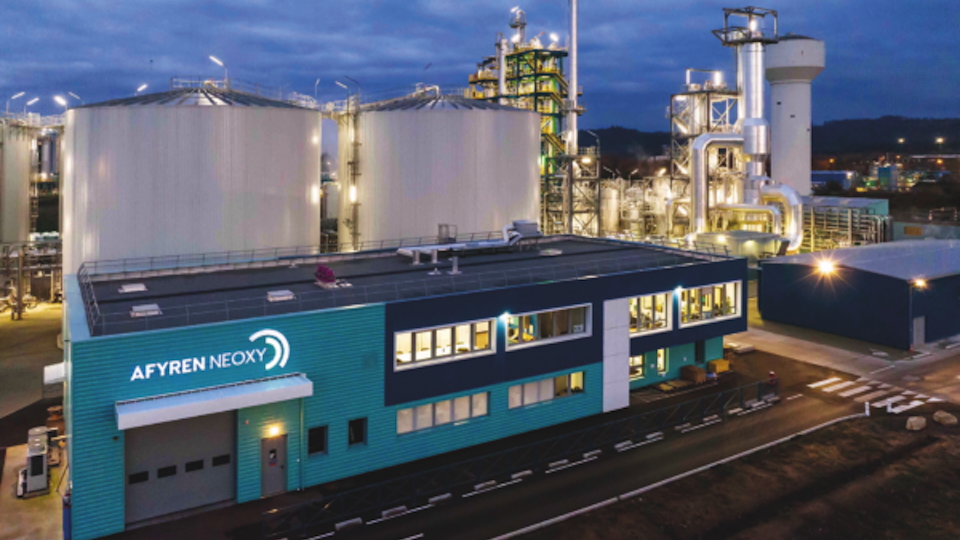
French greentech company Afyren has strengthened its industrial footing with a €23m capital increase, only weeks after announcing that its first commercial biorefinery, Afyren NEOXY, reached continuous production. The two developments together mark a significant inflection point for the firm’s long-term strategy: scaling bio-based organic acids at competitive cost, while proving that circular, low-carbon chemistry can be industrialised at European scale.
The new funds – €20m from US-based sector leader Kemin Industries and €3m from strategic shareholder Bpifrance’s Large Venture fund – will be channelled directly into the optimisation and expansion of the NEOXY plant in Carling-Saint-Avold, close to the French–German border. The investment lifts the facility’s targeted annual capacity from 16,000 to roughly 20,000 tonnes, a more than 20% increase, and reinforces Afyren’s ambition to become Europe’s benchmark supplier of bio-based carboxylic acids.
For Kemin, a long-standing customer of Afyren’s since 2018, the move represents both a strategic supply-chain decision and a deeper alignment with sustainable manufacturing. The US company will have a share in the ownership of about 22%. The subscription price of €2.40 per share, a 9% premium to the previous three-day VWAP, reflects unusual confidence in a sector where capital scarcity and scale-up risk often deter industrial buyers from taking sizeable equity stakes.
Chief Executive Nicolas Sordet called the financing “a strong endorsement of our industrial model”. Afyren has long argued that bio-based chemistry must compete on performance and price, not on eco-premiums. “We share with Kemin the belief that sustainability must be competitive,” he said. The fresh capital, together with grants and project-level debt, covers the bulk of the €20m optimisation programme and provides headroom for the plant’s full ramp-up.
From pilot to industrial reality: NEOXY reaches continuous production
The financing builds on operational momentum at NEOXY, which recently shifted from commissioning into regular, continuous production, two years after construction began. The plant uses a proprietary biomimetic fermentation process to convert agricultural by-products into seven high-value organic acids. The process is circular, produces no waste, and offers a markedly lower carbon footprint than petrochemical production routes.
Over recent weeks, the facility has produced hundreds of tonnes of material undergoing final qualification before shipment under multi-year supply contracts. Afyren has already secured more than €165m in contracted revenue commitments across nutrition, cosmetics, life sciences, agriculture, lubricants and materials science.
At full output, NEOXY is expected to deliver €35m in annual revenue with an EBITDA margin of around 25%. Afyren anticipates reaching positive EBITDA within the next few quarters — a pace almost unheard of among industrial biotech scale-ups.
A strategic turning point for a sector in transition
The company’s trajectory is the result of more than a decade of development. Speaking with European Biotechnology News earlier this summer, Sordet reflected on Afyren’s formative years and the rationale for building and operating production plants rather than licensing the technology — a route many biotech start-ups attempt but rarely succeed with.
“The value lies in what we do and how we do it,” he said. “You must prove you can produce competitively at industrial scale before the market takes you seriously.”
This conviction pushed Afyren to develop a fully integrated model: controlling technology, feedstock strategy, fermentation processes and downstream purification. Instead of relying on genetically modified strains, the platform uses a diversified microbial consortium, improving robustness and reducing dependence on single feedstocks.
The company’s industrialisation was strongly supported by After-Biochem, an EU-backed bioeconomy consortium involving partners in France, Germany and Belgium. German agrifood giant Südzucker, one of the key project partners, recently agreed to extend the collaboration beyond the period of public funding — a sign, Sordet noted, that industrial clients see long-term value in Afyren’s molecules.
Financing the bioeconomy: a fragile landscape
Despite encouraging progress, Sordet remains candid about the systemic weaknesses in Europe’s industrial biotech ecosystem. Scaling a process from lab to commercial volume requires hundreds of millions of euros, yet — unlike pharma — industrial biotech lacks a clear, structured investment and exit model.
“Industrial biotech sits awkwardly between venture capital and private equity,” he said. “VC funds are too small and time-limited; PE funds want immediate cash flow. To bridge the gap, you need a mixed strategy and a lot of perseverance.”
Afyren’s own funding history reflects this: early backing from Sofinnova Partners (who are still owner with about 12%), EU support linked to sustainability objectives, and ultimately an IPO — timed just before equity markets cooled dramatically. For Sordet, the lesson is clear: Europe must adopt a financing architecture that mirrors the pharma model, where early innovation can reliably flow into industrial players prepared to scale it.
“Without that,” he warned, “big industry won’t engage early enough, start-ups will fail, and the innovation will disappear.” For Sordet, the company stands at a critical juncture: “We are no longer a start-up with a promising technology. We are an industrial producer. And now the market is watching how fast we can scale.”
With its first plant now in continuous operation and its financing runway extended, Afyren enters 2026 not only as a technological pioneer but as one of the few companies demonstrating that circular, low-carbon chemistry can be produced at competitive cost and commercial scale.


 BIOCOM / aminul788 - Adobe Stock