
Nine pharma companies urge Europe to invest more in medicines
European biotech and clinical-research figures broadly agree with nine major drugmakers whose chairs signed a letter urging governments to reward new medicines better, but say the fixes go well beyond price.
Why it matters: “The letter we signed this week reflects a reality that the pharmaceutical industry has observed for years: Europe is losing ground in the race for innovation,” a spokesperson from Sanofi told European Biotechnology.
- Europe’s share of global pharmaceutical R&D has fallen from 43% in 1990 to 31%, the signatories write. The European Economic Area’s share of industry-sponsored clinical trials fell from 22% to 12% between 2013 and 2023, while China’s rose from 5% to 18%, according to the European Commission.
- The signatories argue a comeback is still possible; industry studies sketch the payoff. A 50% rise in clinical trials could add 82,000 jobs and €17.9 billion a year to the economy, a Frontier Economics study for the European Federation of Pharmaceutical Industries and Associations (EFPIA) estimates. EFPIA’s own benchmarking report says EU industry R&D investment growing 8.5% a year instead of 5.4% could add €105 billion by 2035.
- “Europe needs to reward investment in drug development if it wants to remain a leading location for pharmaceutical innovation,” said Martin Krauss, co-founder of Munich contract research organization FGK Clinical Research.
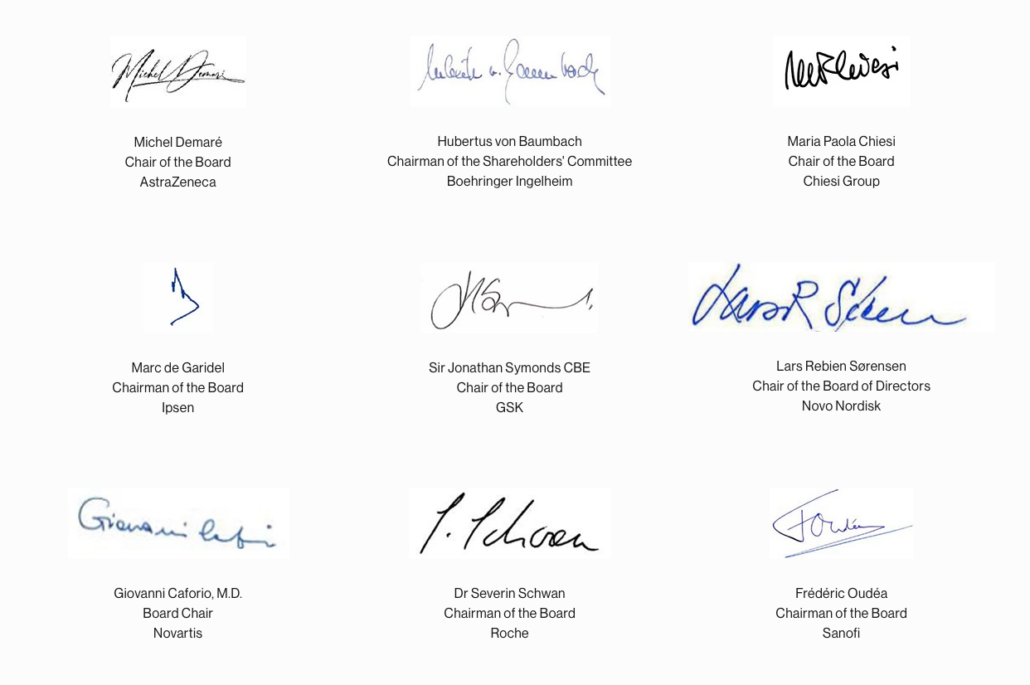
Zoom in: The letter, published Sept. 22, is signed by the chairs of AstraZeneca, Boehringer Ingelheim, Chiesi, GSK, Ipsen, Novartis, Novo Nordisk, Roche and Sanofi. It blames decades in which Europe “treated medicines as a cost to suppress,” with arbitrary budget caps and spending that lags inflation, and says the decisions that count most rest with national governments.
- In the average EU country, 45% of the 168 medicines centrally approved in 2021-2024 were available to patients by January. The average time to availability was 597 days, according to EFPIA’s latest access survey.
- On the national level, the signatories want bigger health budgets, faster assessment and funding of new medicines, and value frameworks that count a treatment’s benefits to patients, health systems and the economy.
- From the EU, they want faster clinical trials, protection of intellectual property, sensible digital rules and fiscal flexibility for member states investing in health and innovative medicines. The EU’s pharmaceutical reform, provisionally agreed in December, cuts baseline market protection for new medicines from two years to one, although qualifying medicines can earn additional protection.
- “Europe does not have a science problem. It has a value-capture problem,” said Peter Nestorov, a biotech entrepreneur and head of industry partnerships at UZH.ai, who spoke in a personal capacity. “We create world-class science and early innovation, but too often fail to finance it through scale-up, commercialise it in Europe and reward it when it demonstrably improves patient outcomes.”
- The European Commission did not respond to a request for comment by press time.
The big picture: The letter lands as Washington pressures Europe over drug prices and Beijing sets explicit targets to move further up the pharmaceutical innovation chain. The signatories say more than $600 billion (€526 billion) of pharmaceutical investment has been announced in the U.S. and China over the past two years. AstraZeneca alone has committed $50 billion (€44 billion) in the U.S. by 2030 and $15 billion (€13 billion) in China.
- Britain agreed last December to raise the net price it pays for new medicines by 25% in exchange for exemption from U.S. tariffs, and the cost-effectiveness threshold NICE applies to new drugs rose by about a quarter in April. In June, the U.S. Trade Representative opened a trade investigation, which can end in tariffs, into what it calls Germany’s persistent underpayment for innovative drugs; a public hearing was set for Sept. 22, the day the letter appeared.
- China’s 2026-2030 pharmaceutical plan, published Sept. 18, calls for drugs developed in China to account for at least a quarter of first-in-class medicines worldwide.
Reality check: Europe is losing R&D share, not R&D spending. EFPIA’s benchmarking report puts EU pharmaceutical R&D growth at 5.4% a year, against 6.4% in the U.S. and 12.1% in China. Europe is being outgrown rather than experiencing an absolute decline in research investment.
- Both Nestorov and Krauss broaden the diagnosis beyond medicine prices. Nestorov emphasizes Europe’s shortage of growth capital for biotech and deep tech, including money from pension and sovereign funds, while Krauss points to trial start-up, recruitment, reimbursement and stable incentives as parts of the same investment environment.
Who pays: The difficult part is deciding how much of Europe’s competitiveness problem health budgets should be asked to solve. Benedetta Baldini of the European Social Insurance Platform said at a debate hosted by consumer group BEUC this summer that Europe already faces “an unprecedented increase in pharma prices,” and argued that health budgets should not be diverted to pharma innovation policy.
- Nestorov’s answer is not simply to pay more, but to pay more explicitly for results. “One model could combine a base reimbursement with an outcomes-based component that is paid when an intervention delivers a predefined and meaningful improvement for the patient,” he said. That requires interoperable digital health records capable of tracking outcomes over time.
- Krauss arrives at the same infrastructure problem from the trial side. He wants hospital systems with structured data and secure digital records to strengthen recruitment, alongside faster approvals, simpler contracts and more consistent acceptance of risk-based approaches by regulators and inspectors.
- Germany illustrates the conflict. It is raising the mandatory rebate on most branded prescription drugs from 7% to 15.5% in January. At the same time, parliament has asked the government to examine exemptions that reward pharmaceutical production and investment in Germany, provided health-insurance contributions remain stable.
Bottom line: Europe does not lack medical research. The test is whether better rewards for innovation, faster trials and stronger investment incentives are enough to keep the next drug-development programme — and the capital behind it — in Europe.
 adobe stock photos - Michael Derrer Fuchs
  lkov - adobe stock photo
 Daniel Torok, Public domain, via Wikimedia Commons