EVerZom leads €13.3M EU project to test extracellular vesicles where Takeda failed
French biotech EVerZom is leading a consortium that has secured €13.3 million in EU funding to bring its extracellular vesicle-based therapy for Crohn’s disease-associated perianal fistulas into clinical trials. The project comes as the company shifts its focus from biomanufacturing technology to drug development.
Backstory: EVerZom is revisiting an indication where regenerative medicine has already experienced a major setback. In December 2024, Takeda withdrew its stem cell therapy Alofisel from the European market following the failure of a confirmatory Phase 3 trial. The French biotech believes it could overcome some of the limitations of cell therapies by using the biological material secreted by the cells rather than the cells themselves.
Complex perianal fistulas are a debilitating complication of Crohn’s disease in which abnormal channels develop between the lower intestine and the skin around the anus, causing pain, persistent discharge and recurrent infections. Despite treatment with biologics and surgical interventions, many patients experience recurrence and require additional surgery.
Alofisel (darvadstrocel), a therapy based on mesenchymal stromal cells derived from donor fat tissue, offered a regenerative approach to treating these fistulas. However, in a confirmatory Phase 3 trial involving 568 patients, combined remission at 24 weeks was achieved in 48.8% of patients receiving Alofisel, compared with 46.3% of those receiving a placebo.
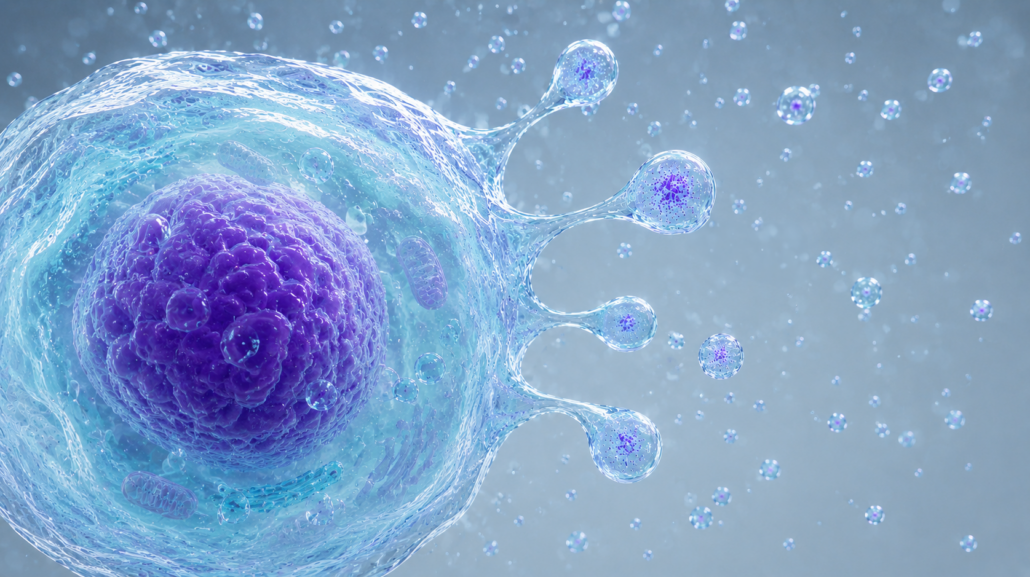
How it works: EVerZom’s lead candidate, EVerGel, uses extracellular vesicles (EVs) derived from mesenchymal stromal cells sourced from fat tissue. These nanoscale particles are naturally released by cells and carry biological molecules involved in communication between cells, including proteins, microRNAs and lipids.
The company’s treatment combines an injectable solution administered around the fistula to modulate local inflammation with a temperature-sensitive hydrogel delivered directly into the fistula tract. The gel retains the vesicles locally, allowing their gradual release to support tissue repair.
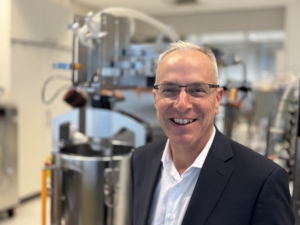
Nicolas Rousseau, co-founder and chief operating officer of EVerZom, told European Biotechnology that the company expects several aspects of its approach to differentiate EVerGel from Alofisel:
- Stability: Extracellular vesicles are less fragile than living cells, which could simplify storage, transportation and administration.
- Consistency: While transplanted cells secrete different biological factors depending on their surrounding environment, EVerGel delivers a standardized dose of vesicles with a controlled composition.
- Repeated administration: Unlike Alofisel, which was administered once, EVerGel will be given twice, six weeks apart, to support different stages of tissue healing.
- Local retention: According to Rousseau, the company’s data indicate that more than 70% of the product remains at the administration site after one week when delivered with the hydrogel.
EVerZom is also developing a series of potency assays to measure the immunomodulatory and regenerative activity of its vesicles and ensure consistency between manufacturing batches. Three assays have already been developed, with six more to be evaluated through the consortium.
Among the scientific leaders of EVerZom’s consortium is Damián García-Olmo, a researcher at Fundación Jiménez Díaz University Hospital in Madrid and a pioneer in the use of mesenchymal stromal cells to treat complex perianal fistulas.
Into the clinic: EVerZom plans to enroll its first patient in October 2027, subject to regulatory approval. Rousseau shared details of the clinical development program, which will include two studies:
- A first-in-human, open-label Phase 1b/2a trial enrolling 29 to 38 patients, including a dose-escalation stage and a 20-patient expansion cohort.
- A subsequent Phase 2b trial involving about 120 patients, for which the detailed design has yet to be disclosed.
The first study will primarily assess safety and tolerability over 24 weeks, alongside preliminary efficacy measures such as clinical remission, fistula closure and recurrence. MRI assessments will also be used to explore healing of the underlying fistula tract.
Given the difficulties encountered with Alofisel, EVerZom is placing particular emphasis on selecting a refractory patient population and standardizing surgical procedures across clinical centers to minimize factors that could confound efficacy results.
By the numbers: The five-year consortium, named SATURN, brings together 12 organizations across France, Spain, Germany, Italy and Belgium. While only €2.7 million of the €13.3 million grant is allocated directly to EVerZom, Rousseau confirmed that the overall funding package covers the Phase 2 clinical trial and associated development activities, with costs distributed among the different partners.
The funding follows a €10 million Series A financing in 2025 and the company’s selection under the France 2030 program to support industrial-scale manufacturing of extracellular vesicles.
Between the lines: The project also reflects a fundamental change in EVerZom’s business model. Founded in 2019 as a spinout from French research institute Inserm, the company initially focused on developing and industrializing its proprietary extracellular vesicle production technology. “EVerZom is now primarily positioned as a drug development company, with more than 80% of our financial resources dedicated to the clinical development of our lead therapeutic candidate, EVerGel,” Rousseau told European Biotechnology. The company intends to build a pipeline around the same active pharmaceutical ingredient, applying its extracellular vesicles to different therapeutic indications.
In November 2025, EVerZom entered into a research collaboration with fellow French biotech GENFIT to develop a treatment for acute-on-chronic liver failure, a life-threatening complication of chronic liver disease. GENFIT holds an exclusive option to license the candidate, EViv, pending successful preclinical proof of concept. EVerZom is also exploring applications in ophthalmology.
What to watch: EVerGel’s clinical development will be an important test of whether the therapeutic properties of mesenchymal stromal cells can be harnessed without administering living cells. While EVerZom has identified several potential advantages over earlier cell therapies, it has yet to establish whether these translate into better clinical outcomes in patients.