
Commit Biologics secures $60M to advance complement-based immunotherapies
Danish biotech Commit Biologics has completed a $60 million (€54 million) seed financing round to advance its first complement-powered immune engager toward clinical trials. The closing follows the nomination of its first drug candidate and several senior appointments as the company prepares to enter the clinic.
Why it matters: The financing marks a new stage for the Aarhus University spinout, which is moving from platform research toward clinical development. It also brings two corporate venture investors, AbbVie Ventures and M Ventures (the corporate venture arm of Merck KGaA), into its shareholder base.
Backstory: Commit has built up its financing over several years. It emerged from stealth in May 2024 with €16 million from Novo Holdings and Bioqube Ventures. In January 2025, it secured another €5.5 million from Belgian investor Korys, bringing its seed funding to €21.5 million.
The final closing, led by Belgian investment group Ackermans & van Haaren, brings the total to $60 million. Existing investors Novo Holdings, Bioqube Ventures and Korys also participated.
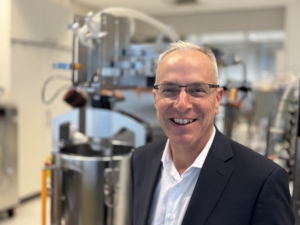
“Commit was founded on a simple idea: that complement, one of the most powerful parts of our immune system, could be deliberately directed against diseased cells. With this financing, we will take COM002, a first-in-class immune engager that works independently of T cells, into the clinic and build the foundation for complement-powered immune engagers to become a new pillar of immunotherapy,” said Dr. Thomas L. F. Montgomery Andresen, CEO of Commit Biologics.
Zoom in: The proceeds will finance investigational new drug (IND)-enabling studies and regulatory filing preparations for COM002, Commit’s first development candidate, nominated just a few days ago by the company.
- COM002 initially targets relapsed or refractory non-Hodgkin lymphoma, with potential expansion into autoimmune diseases.
- The company expects to dose its first patient in early 2028.
- Funding will also advance a second program into IND-enabling development and support further pipeline expansion.
How it works: Conventional T-cell engagers use bispecific antibodies to bring T cells into contact with diseased cells and trigger their destruction. Commit’s Bispecific Complement Engager (BiCE) platform takes a different approach. Its engineered antibodies bind a target on the diseased cell while recruiting C1q, a protein that activates the complement system. This triggers a cascade that can destroy the cell directly or mark it for removal by other immune cells.
Unlike T-cell engagers, BiCE molecules do not depend on the presence or activity of T cells, which can become exhausted or struggle to penetrate certain tissues. Complement proteins are continuously replenished and could therefore offer a way to eliminate diseased cells even when T-cell activity is limited.
There is also a potential safety benefit. T-cell engagers can trigger excessive immune activation, leading to cytokine release syndrome. By bypassing T cells, Commit hopes to avoid some of these complications.
Early evidence: In human whole-blood experiments, Commit reported stronger B-cell depletion than with an approved T-cell engager. A subsequent study in nonhuman primates showed sustained B-cell depletion for more than four weeks after a single dose, without cytokine release or treatment-related safety findings.
However, these findings remain preclinical. Whether complement-powered therapies can match or outperform T-cell engagers in patients, particularly in terms of safety, remains to be demonstrated.
Building the leadership team: The financing follows a series of appointments that reflect Commit’s transition toward clinical development.
In March, Thomas L. F. Montgomery Andresen became CEO. A serial biotech entrepreneur, he previously led T-Cypher Bio, and co-founded Torque Therapeutics, which was later acquired by Repertoire Immune Medicines.
Last week, Commit also appointed Anne-Marie Levy Rasmussen as chief operating officer and Benjamin Ole Wolthers as head of clinical development. Rasmussen previously served as COO of Gubra and CEO of Innovation Fund Denmark, while Wolthers brings clinical development experience from Kite Pharma, Galapagos and Evaxion, including work on CAR-T trials.
The financing also reshapes Commit’s board. Michael Rosenzweig of AbbVie Ventures, Charlotte Kremers of M Ventures and Lenny Van Steenhuyse of Ackermans & van Haaren are joining as directors.
What’s next: Commit now has financing, an expanded leadership team and a nominated development candidate. The next test will be translating its preclinical findings into human studies, with first patient dosing planned for early 2028.