The Strüngmann legacy, passed on
Thomas and Andreas Strüngmann have spent decades building pharmaceutical companies and backing biotech entrepreneurs, most famously BioNTech. Now, as a new generation takes a larger role in their family office, an award bearing their name is turning that investment philosophy into a search for Europe's next biotech builders.
When Thomas and Andreas Strüngmann stepped down as voting members of the supervisory board of Athos, the family office that manages the Strüngmann family’s investments, at the end of 2023, the next generation faced a question: How do you mark the legacy of two entrepreneurs who have never been particularly interested in monuments?
The answer came from the next generation. “It was the idea of the next generation, our children,” Thomas Strüngmann told European Biotechnology in one of his rare media interviews. With biotech at the center of the family’s investments, he said, they wanted to create an award “for the future” and as “recognition” for entrepreneurs — a more fitting tribute than, as he put it, “a statue on Rosenheimer Platz” in Munich.
The award reflects a pattern that has shaped the brothers’ careers for decades: first building pharmaceutical companies themselves, then using the proceeds to back other entrepreneurs in life sciences.
The Strüngmann playbook
The twin brothers founded generics maker Hexal in 1986 and built it into Germany’s second-largest generics company. In 2005, Novartis agreed to acquire Hexal alongside the Strüngmann family’s 67.7% stake in U.S. generics company Eon Labs for a combined €5.65 billion. The businesses were folded into Sandoz, helping turn the Novartis division into the world’s largest generics company at the time.
The exit gave the brothers the capital to do something they would repeat on a different scale: investing in entrepreneurs and technologies they believed could become very successful businesses.
BioNTech is the defining example. When the Mainz company was founded in 2008 by Uğur Şahin, Özlem Türeci and Christoph Huber, the Strüngmann brothers and MIG Fonds were among the backers providing $180 million in seed financing. ATHOS still owns about 40% of the company, according to Wolfgang Essler, managing director at ATHOS.
But BioNTech is only the most visible part of a much broader portfolio. ATHOS remains heavily allocated in life sciences and healthcare, ranging from wholly owned pharmaceutical businesses such as Megalabs in Latin America and Aristo Pharma in Europe to a 24% stake in biosimilar developer Formycon and roughly a dozen significant earlier-stage biotech investments.
Essler describes ATHOS as an “active owner”: the family office generally prefers private companies, seeks direct contact with management and often takes board seats. “We usually want to have a say in the companies,” he said. Compared with a textbook family-office portfolio, ATHOS is unusually weighted toward direct investments. As the next generation takes a larger role, Strüngmann wants to preserve two traits: “We are fast decision makers and we take on calculated risks.”
That philosophy is now being distilled into the award.
What the award rewards
The Strüngmann Award comes with a €100,000 cash prize for the winner, but Strüngmann says that is not its main purpose. Instead, the award is “a recognition of what is done” and a way “to show other companies what’s possible,” he explained.
Finding the right moment to give that recognition has taken some calibration. At one end are entrepreneurs whose success is already beyond dispute, such as Şahin and Türeci. “They achieved everything,” Strüngmann said of the BioNTech founders. “They don’t need it anymore. That’s not the sense of the award.”
At the other end are scientists who have just left university with an idea and a handful of colleagues. That may be an exciting beginning, but it does not yet prove entrepreneurship. Matthias Kromayer, who heads life science activities at MIG and sits on the award jury, warns against honoring “would-be entrepreneurs” on ambition alone.
The jury therefore looks for a narrow but important middle ground. Scientific innovation “really has got to be disruptive in a way,” Kromayer said, but it also needs translational impact: “Is there a translation into clinic, into marketable products?” The jury also looks at whether founders have been able to attract capital and turn it into value, as well as leadership and the ability to build a team rather than a business around a single “godlike person.”
The first two editions give a sense of that sweet spot. In 2024, the award went to HAYA Therapeutics co-founders Samir Ounzain and Daniel Blessing. Since then, the Swiss RNA biotech has entered into a collaboration with Eli Lilly worth up to $1 billion and moved its lead program HTX-001 into Phase 1. In 2025, the award went to Araris Biotech founders Dragan Grabulovski, Philipp Spycher and Isabella Attinger-Toller, shortly after Taiho Pharmaceutical agreed to acquire the Swiss ADC company for up to $1.14 billion. This year’s finalists are at different points on that same trajectory.
Three ways to take the leap
This year’s finalists arrived at entrepreneurship from very different directions. Stefano Portolano, CEO of Azafaros, left medicine and basic research for Genzyme in 1998, when rare diseases were still “a little more than an exotic curiosity.” Looking back, he says the move taught him to take chances “when the direction of the field was not obvious.”
Wieland Sommer, founder of Jacobian, walked away from a newly secure academic career after becoming one of LMU Munich’s youngest radiology professors. “What I risked was exactly the thing I had worked hardest for,” he said.
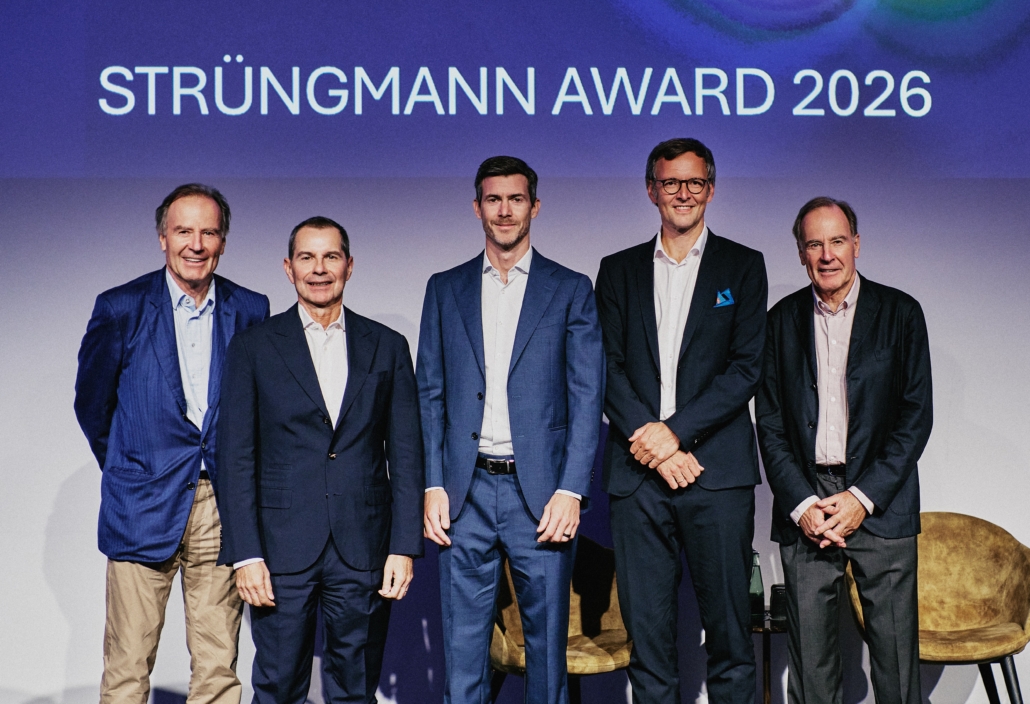
The jury ultimately chose Jonathan Talbot, CEO of Mosanna Therapeutics and Melodia Therapeutics, as the 2026 winner. Talbot chose biotech over a conventional investment-banking career and has since built a playbook around revisiting drug candidates that have fallen by the wayside, asking whether a different structure, delivery method or indication could give them another chance.
“I am interested to add value to those drug candidates that give at least some information about their mode of action,” Talbot said. “Is there a possibility for improvement by structural means or by finding a better way of delivery?”
Together, the three finalists offer different versions of the entrepreneurial profile the jury is trying to identify: people whose scientific ambitions have already survived first contact with the much messier task of building a company.
Beyond Germany
So far, the award has concentrated on Germany, Austria and Switzerland but that’s about to change. Strüngmann said the intention is now to expand it toward Europe to broaden the pool of candidates while also giving the award a more international profile.
The move also reflects the environment in which the next generation of biotech entrepreneurs will have to operate. Strüngmann remains bullish on Europe’s fundamentals, pointing to its “very well educated workforce” as a strength. Kromayer sees progress too: experienced C-level talent, he said, was a weakness a decade ago but is much stronger today. The bigger problem is fragmentation, with Europe still lacking integrated capital markets and remaining divided by national barriers in regulation, pricing and market access.
An award cannot solve those structural problems, nor is it intended to, but what it can do is put attention on the people trying to build companies despite them.
Passing it forward
That makes the timing of the award significant. At 76, Thomas Strüngmann says he is “slowly fading out” of the family office. The Strüngmann brothers remain major shareholders and regular presences, but the next generation is taking a larger role in supervising ATHOS and shaping its strategy for the coming decade.
The footsteps are large. The brothers built Hexal, turned the proceeds into one of Europe’s most consequential pools of life science capital and helped finance BioNTech long before mRNA became a household term.
But perhaps the more interesting legacy is not any single company. It is the conviction that European entrepreneurship needs people willing to leave the comfort of science alone and build something around it.
Asked what he would look for after 50 years in the pharmaceutical industry, Strüngmann eventually reduced it to one word: “passion.” The award carrying his and his brother’s name is an attempt to find where that passion turns into entrepreneurship and, increasingly, to look for it across Europe.