
“AI biotech” is no longer a useful category for investors
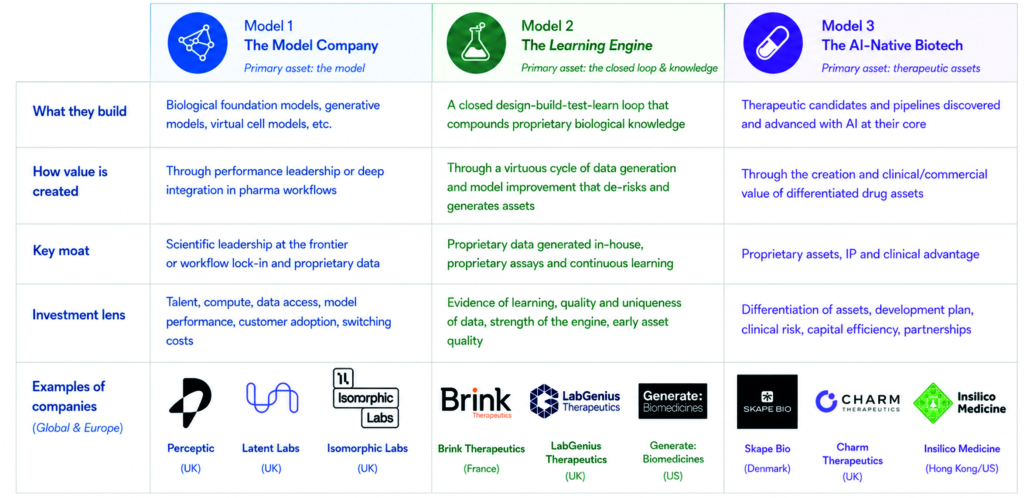
AI has transformed drug discovery, but the “AI biotech” label has become increasingly misleading. Kurma Partners proposes an investment framework that distinguishes three fundamentally different models — each building a different asset, creating value in a different way and requiring a different investment lens.
Over the last five years, AI has changed what is possible in biology. AlphaFold2 and the 2024 Nobel Prize in Chemistry marked the moment AI solved one of science’s hardest problems: predicting how a protein folds from its sequence alone. Generative models for protein and molecule design followed, and foundation models trained on genomic, single-cell, clinical and imaging data are now deployed across the full development pipeline, from target identification to trial design.
None of this was straightforward: large language and diffusion models were built for text and images, not biology, which is messy, incomplete and governed by constraints with no equivalent in language. Understanding the underlying biology, not just pattern matching, is what every so-called AI biotech company is racing to solve, with different architectures and very different value propositions.
The investment landscape reflected that momentum: AI biotech companies raised roughly $3.8 billion in 2025, one of the strongest years on record, while Big Pharma’s AI partnerships grew about 120% year on year between 2024 and 2025.
In this environment, differentiating signal from noise is hard: value propositions converge on the surface, yet the underlying businesses are fundamentally different in what they build and where the value sits. Here’s one segmentation we found most useful in practice: three distinct business profiles, each requiring its own value creation lens and risk framework.
Model 1: the model company
The first category consists of companies whose primary asset is the model itself: biological foundation models, protein generation systems, virtual cell models, etc. These businesses are not developing a drug; they are building the ability to predict, design or interpret biology at a level not previously possible. Two distinct businesses operate under this label. Frontier model builders are large-scale, talent-intensive operations whose value rests on sustained scientific leadership. Integration-oriented platforms compete differently, becoming so embedded in pharmaceutical workflows, through adoption, customer data and operational importance, that switching away is more disruptive than staying.
Competition for both is brutal, from the best-funded labs and from an open-source ecosystem that keeps raising the floor on what “good enough” means. Only a handful of companies have the capital and talent density to credibly compete at the frontier. But the deeper challenge is validation: in most technology markets, performance is easy to measure, but biology rarely offers that clarity. A model can generate structurally plausible proteins, score well on every available benchmark and still fail to capture the biology that matters for a drug to work. Some Model 1 companies address this by running their own wet labs or partnering with external ones, to ground the model’s output in real experimental data.
Evaluating a Model 1 company means asking different questions depending on the strategy: talent, compute and proprietary data access for frontier builders; depth of embedding, accumulated customer data and switching cost for integration platforms. The valuation logic and the risk profile differ accordingly.
Model 2: the learning engine
The second category is built around a closed design-build-test-learn loop. The model improves because the lab generates data; the lab becomes more efficient because the model improves. The wet lab is not a cost center, it is the engine, and it is what makes the system hard to replicate from outside. As the loop matures, it naturally produces therapeutic candidates as a by-product, giving these companies a dual source of value: the platform and the assets it generates.
But biological data is scarce by nature, expensive and slow to produce, and quality matters far more than quantity. The companies that hold a structural advantage are those that control how data is produced, often through proprietary assay technology that captures properties standard methods cannot, and that treat experimental noise as information rather than error to be filtered out.
Evaluating a Model 2 company means assessing two things at once: whether the loop is actually improving, and what feeds it.
Model 3: asset-first AI biotech
The third category consists of companies that use AI to augment R&D but remain therapeutics businesses by DNA. It changes how candidates are discovered and how fast, not the fundamental nature of what is being built: a drug candidate that must demonstrate biological validity, safety and clinical efficacy. Many use genuinely sophisticated AI to access biology conventional tools struggle to reach. But once the asset exists, it is the drug candidate, not the platform, that needs to work.
This is where the most money gets lost to category confusion. These companies attract valuations that price in both an AI platform story and therapeutic upside, without fully underwriting either. The biology is not de-risked because an algorithm designed the candidate: the same failures that have governed drug development for decades still apply. You are backing a biotech, and the diligence, milestones and risks to price are those of a therapeutics company, not an AI company.
Evaluating a Model 3 company means asking biotech questions first. The AI question is secondary. The team is a tell: only ML researchers, with no drug developers, often signals the transition hasn’t happened yet. Excellent AI does not file an IND.
What risk are you underwriting?
These boundaries are not fixed, and companies move between models. A Model 1 platform can start running its own programs to prove the model works on real targets, and pipelines have a way of taking over: investors who backed the model end up funding the biology instead. The same dynamic plays out between Model 2 and Model 3. A learning engine will generate drug candidates as proof points, not endpoints, but if the value is really in the assets rather than the platform, an investor who priced it as a platform is exposed to biotech risk, biotech timelines and biotech multiples without knowing it.
The framework is not about putting companies in boxes. It is about forcing clarity on a single question that determines valuation, milestones, diligence and what needs to be true for the investment to work: what risk are you actually underwriting? A foundation model and a drug candidate require completely different frameworks, different comparables and different exit paths. Treating them the same is where the money gets lost.
About the authors: Benjamin Belot is a Partner for the Healthtech franchise, Samantha Zennou an Associate and Louise-Marie Rakotoarison an Analyst at Kurma Partners.