


RNA medicine enters its second act
The COVID-19 pandemic transformed RNA technologies into one of the most visible scientific breakthroughs of the decade. mRNA vaccines demonstrated unprecedented speed of development, large-scale manufacturing capability and global deployment, pushing RNA therapeutics into the public spotlight. But according to companies working in the field, the pandemic was not the beginning of the RNA story. Instead, it accelerated technologies that had already been under development for years.
“RNA therapeutics were actually being developed in oncology well before COVID-19,” explains Jon Moore, Chief Scientific Officer of Epitopea. “Companies such as BioNTech and Moderna had already been working on personalised cancer vaccines for many years before the pandemic, with publications dating back to at least 2016.”
What changed during COVID-19 was the validation of RNA at industrial scale. “COVID-19 really demonstrated the speed, scalability and safety profile of mRNA technology,” Moore says. “The pandemic accelerated public awareness and validated the platform at a global scale.”
Today, the field is rapidly evolving beyond vaccines into oncology, cardiovascular medicine, autoimmune disease and gene regulation. Increasingly, RNA is being viewed not as a single product category, but as a programmable therapeutic platform.
One technology, different medicines
One of the central themes emerging across the RNA field is that “RNA therapeutics” encompasses multiple fundamentally different modalities. “It’s important to remember that RNA therapeutics is not one type of medicine,” says Dr David H Solomon, CEO of Thalia Therapeutics. “There’s siRNA, which is double-stranded RNA that silences genes; there’s microRNA, which are small pieces of RNA that modulate gene expression; and then there’s mRNA proper, as in the COVID vaccines.”
Rather than representing a single technology, RNA therapeutics are built around the broader biological principle that RNA sits at the centre of gene expression and protein production. “RNA therapeutics is a class based on the idea that the central dogma of life is: DNA makes RNA makes protein,” Solomon says.
That diversity is increasingly allowing developers to approach RNA as a flexible engineering platform capable of encoding multiple biological functions. “One of the key advantages of mRNA is its flexibility and portability as a platform,” Moore explains. “You can encode antigens, cytokines, antibodies or other therapeutic proteins, and potentially combine multiple mechanisms simultaneously.”
The platform nature of RNA is also changing how companies think about therapeutic development. Unlike traditional biologics or viral vector systems, RNA technologies can potentially be adapted more rapidly across different disease areas and targets. Compared with viral vectors, Moore notes that mRNA can also avoid some of the limitations associated with repeat dosing. “With viral vectors, patients often develop antibodies against the delivery vehicle itself,” he says. “mRNA-based systems generally allow for multiple redosing cycles, which is highly valuable in cancer treatment.”
The first clinically validated RNA medicines
While public attention largely focused on mRNA vaccines during the pandemic, the first clinically validated RNA medicines have emerged from another branch of the field: siRNA.
According to Solomon, gene-silencing siRNA therapeutics currently represent one of the most commercially established RNA modalities. “siRNA, or gene silencing, is the leader in terms of validated therapeutics,” he says. “These medicines are in the marketplace, generating several billion in aggregate revenue for the sponsoring companies.”
Much of that success has come through liver-targeting approaches. By attaching a GalNAc tag to siRNA medicines, developers can efficiently direct therapies into hepatocytes through specific receptors expressed on liver cells. “Insofar as genes in the liver are responsible for a specific disease, by silencing those genes, you can get a complete, almost a cure, of the disease,” Solomon explains. He points to companies such as Alnylam, Arrowhead and Silence Therapeutics as leading players in the field.
At the same time, companies are already looking beyond first-generation siRNA therapeutics toward newer RNA modalities. “The next generation of RNA therapeutics will likely be microRNAs,” Solomon says. “MicroRNAs are short pieces of RNA that modulate gene expression either up or down, rather than silencing it.”
Moore also points to growing momentum around several emerging RNA technologies. “There is increasing interest in using RNA therapeutics for in vivo antibody production, gene replacement therapies and potentially more complex biologics such as T-cell engagers,” he says.
The field is also exploring self-amplifying RNA and circular RNA systems, particularly where developers are seeking longer persistence and extended protein expression.
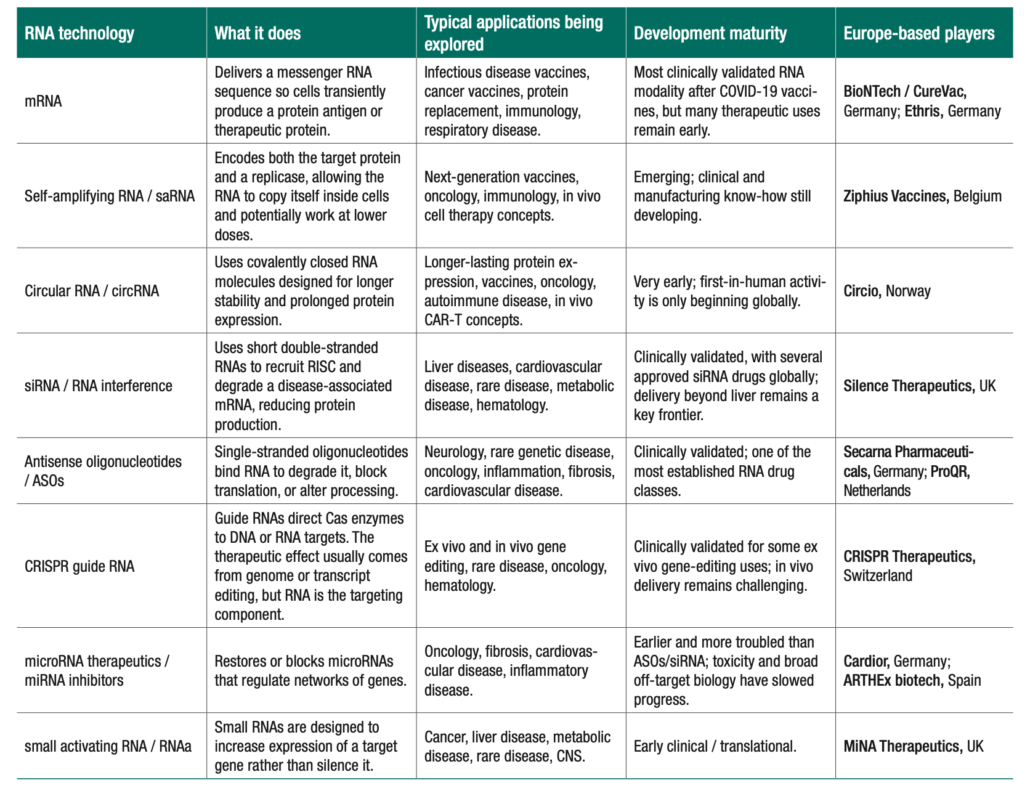
Selected RNA technology classes and European players.
Oncology and the search for new targets
One of the most active areas for RNA development today is oncology. Epitopea is among the companies exploring RNA-based cancer immunotherapies beyond traditional personalised neoantigen approaches. The company focuses on tumour-specific antigens arising from what it describes as the “dark genome” – non-canonical regions of the genome that become activated in cancer cells. “Our approach instead focuses on shared tumour-specific antigens derived from the ‘dark genome’,” Moore explains. “This allows us to develop an off-the-shelf therapy using common antigens shared across patients with a particular tumour type.”
The company believes this could open new possibilities for broader off-the-shelf cancer immunotherapies. “The aim is to
train the immune system to recognise and eliminate residual cancer cells after surgery and chemotherapy,” Moore says, describing the company’s ovarian cancer programme.
At the same time, Thalia Therapeutics sees major opportunities emerging in cardiovascular disease and gene modulation. The company is particularly focused on microRNA and advanced delivery technologies. “Scientists were awarded the Nobel Prize in Medicine and Physiology in 2024 for the discovery of microRNA,” Solomon says. “That’s the new vista for RNA therapeutics.”
The delivery challenge
As the RNA field matures, attention is increasingly shifting toward delivery systems and tissue targeting. Across the industry, developers are trying to move beyond the liver and expand RNA therapeutics into other organs and disease areas. “To date, almost all of the targeting has been to the liver,” Solomon says. “Yet there are many other cells and organs where targeting RNA therapeutics will lead to specificity and even personalised medicines.”
Moore agrees that delivery remains one of the defining areas of innovation. “Delivery technologies remain extremely important,” he says. “Lipid nanoparticle innovation, for example, has been a major contributor to the field’s progress.”
At Thalia Therapeutics, this focus has led to the development of Nuvec, the company’s proprietary silicon nanoparticle delivery platform. According to Solomon, the platform may allow developers to load multiple RNA therapeutics into a single nanoparticle and potentially adjust the ratio between payloads.
“With Nuvec, you can probably load multiple RNA therapeutics into a single silicon nanoparticle and at different ratios,” he says. The company is exploring this approach in cardiovascular disease using dual-acting siRNA combinations against both Lp(a) and PCSK9. Nuvec is also being explored for potentially longer-acting formulations and oral delivery approaches. “So, in short, we’re trying to position Thalia Therapeutics as a nascent RNA therapeutics company and a new European champion in the space,” Solomon says.
Europe’s position in the RNA race
Europe played a central role in the emergence of mRNA during the pandemic, particularly through BioNTech and the rapid expansion of manufacturing infrastructure. “BioNTech played a major role in establishing Europe’s mRNA ecosystem, including manufacturing infrastructure and broader industry capability,” Moore says. He also points to significant GMP manufacturing capabilities now operating across Europe.
At the same time, both executives acknowledge that the global RNA landscape remains highly competitive. “This has largely been an American play, based on American technology patents,” Solomon says.
Still, both companies see major room for European innovation as the field continues to evolve. “While Europe has lagged the US overall, there’s plenty of room for innovation, since the field is still so young,” Solomon says.
Governments are also increasingly viewing RNA strategically, both as an industrial capability and as part of broader pandemic preparedness efforts. “Many governments are now viewing mRNA strategically,” Moore says, “both from an industrial policy perspective and in terms of pandemic preparedness.”
The next phase of RNA medicine
The first wave of RNA therapeutics demonstrated that the technology could work during a global crisis. The second phase is becoming much broader and more ambitious. The field is now moving toward programmable medicines capable of gene silencing, immune activation, protein production and multi-target therapeutic engineering.
At the same time, innovation is occurring simultaneously across RNA engineering, delivery systems, target discovery and manufacturing.
The next decade of RNA medicine may therefore be defined not by a single breakthrough product, but by the convergence of multiple technologies into a new therapeutic platform capable of reshaping how medicines are designed, delivered and personalised.