

Geopolitical shifts in trial outsourcing
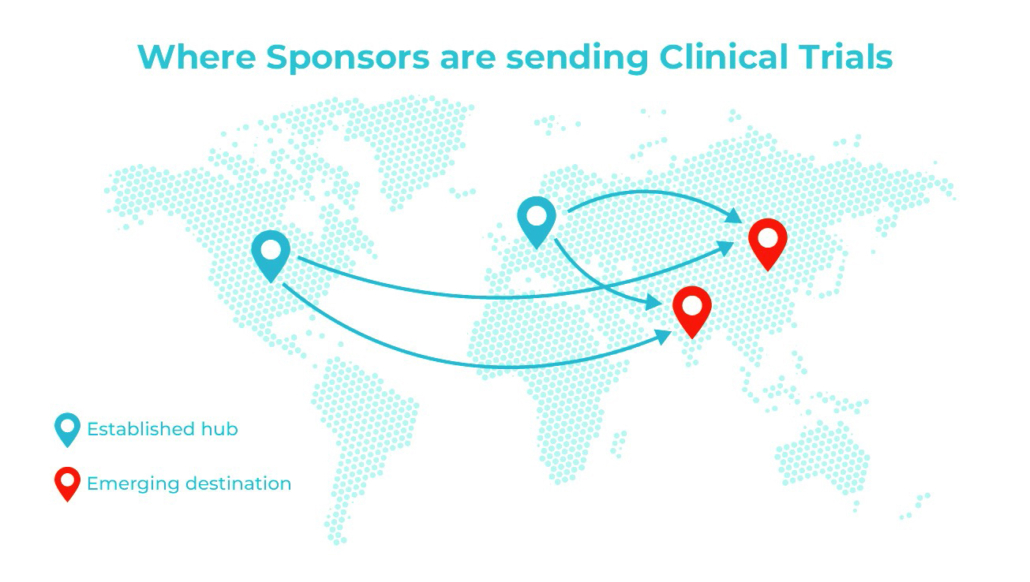
Three developments over the past year have changed what “outsourcing” a clinical trial actually means. New U.S. tariffs on patented pharmaceuticals, a revised Chinese trial standard, and faster approval rules in Europe, the UK and Australia are all forcing sponsors to look again at where trials run and who runs them.
Three developments over the past year have changed what “outsourcing” a clinical trial actually means. New U.S. tariffs on patented pharmaceuticals, a revised Chinese trial standard, and faster approval rules in Europe, the UK and Australia are all forcing sponsors to look again at where trials run and who runs them.
Start with Washington. In April 2026, the U.S. used Section 232 to put tariffs on patented pharmaceuticals and their active ingredients: 100% on standard imports, up to 120% for companies without an approved U.S. manufacturing plan, in force from July 31, 2026 (Crowell & Moring, 2026). Generics, biosimilars and cell and gene therapies are exempt. For sponsors, the practical point is that a supply chain built around a low-cost API source or contract manufacturer now needs a second look, and outsourcing contracts should spell out who carries tariff risk if a product’s status changes.
China tightens oversight
China moved too. Its revised Good Clinical Practice rules, in force from September 1, 2026, adopt ICH E6(R3) but keep the sponsor fully responsible for outsourced work, including CROs and other vendors. A new chapter on data governance requires validated systems, audit trails and tighter access controls, and ethics committees can now intervene further into how a trial is run (Cisema, 2026). China still accounts for roughly a fifth of drugs in global development, so this is not a reason to leave; it is a reason to check that contracts clearly assign quality obligations, and that data systems can withstand an audit.
Europe fights back
Meanwhile Europe, the UK and Australia are competing harder for the trials that might otherwise go to Asia. The EU’s Joint Clinical Assessment allows one review across member states instead of several, part of a push toward 11% more trial volume by 2030 (Clinical Trials Arena, 2026). The UK has cut median trial setup time from 169 to 122 days under a new 150-day rule, and Australia offers a 43.5% refundable tax offset on eligible trial costs through Phase 3 (Clinical Trials Arena, 2026). None of this reverses a decade of share loss to Asia-Pacific on its own, but it does mean cost is no longer the only reason to look outside the traditional hubs.
Risk joins cost and speed
Put together, these three shifts point to the same conclusion: location decisions and CRO selection now carry trade and regulatory risk that didn’t exist a year ago, and that risk needs to sit next to cost and speed on the same checklist, not after it. Sponsors should ask any CRO how a contract handles a tariff change or a new data rule mid-trial, not just how it handles a missed enrollment target. CROs that can run comparable quality systems across two or three regions at once, and show it on paper, will have an easier conversation with sponsors than those that can only point to being cheap or being big.
Contact us:
Lumis International GmbH
Heike Schön, CEO
hs@lumisinternational.com
Sources
- Crowell & Moring, “Trump Administration Imposes Section 232 Tariffs on Patented Pharmaceutical Imports,” 2026.
- Foley Hoag, “Executive Order Imposing Section 232 Tariffs on Pharmaceuticals and Pharmaceutical Ingredients,” April 2026.
- Cisema, “China Revises Drug Clinical Trial GCP to Align with ICH E6(R3),” 2026.
- Clinical Trials Arena, “Countries compete to reform trials in a bid to attract global sponsors,” 2026.
This article is sponsored by Lumis International GmbH
 MAES-AREA-Englos