Switzerland’s biotech sector defies tough markets with record revenue
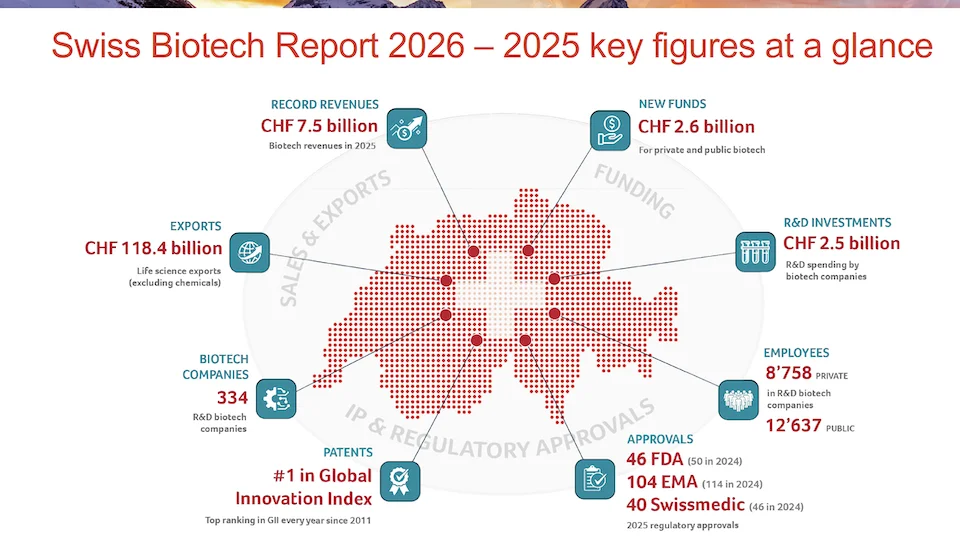
If one follows the figures in the Swiss Biotech Report 2026, the green lights are more prominent than the red warning signals. The Swiss biotech industry continued its growth momentum in 2025 and even reached new record highs. According to the industry report presented in early May at Swiss Biotech Day in Basel, total revenue among companies classified as biotech — which in this case explicitly does not include Roche and Novartis, for example — rose to CHF 7.5 billion, up from CHF 7.2 billion the previous year. The drivers were a growing number of market-ready products and persistently strong demand for specialized CDMO services.
The financing side also presented a stable picture: capital inflows rose slightly, by 2.1%, to CHF 2.6 billion. What stands out is the shift toward privately financed companies. These companies raised CHF 1.15 billion — more than ever before — an increase of 38%. Their share of total financing volume thus rose to 45%. The largest rounds included Windward Bio with CHF 186 million and GlycoEra with CHF 104 million.
From a Swiss perspective, it fits this picture perfectly that Basel-based Windward Bio announced it had once again raised a nine-figure sum, namely US$165 million, on top of the US$200 million Series A it secured just 12 months earlier. Here, drug candidates from China are making it possible for a Swiss company to be equipped with this much money. Some are already speaking of a new biotech model, although perhaps a great deal also depends on the people involved here from the Basel ecosystem.
In the listed segment, by contrast, the environment remained challenging. Nevertheless, BioVersys completed Europe’s largest IPO of the year in early 2025, and the only one in Switzerland. At the same time, partnerships and licensing deals continue to gain importance as a source of financing, said Frederik Schmachtenberg of EY.
Market shifts
The number of product approvals in the U.S., Europe and Switzerland declined slightly, while other markets such as China and Canada gained ground. Investment in research and development fell moderately to CHF 2.5 billion, but remained at a high level. At the same time, employment reached a new record high, with more than 21,000 full-time positions. Here, too, a comparison with industry leader Roche suggests itself: Roche alone reports around 18,000 employees in Switzerland.
Perhaps it is a sign that the dominant players — such as Roche or Novartis — are moving closer to the innovation ecosystem primarily represented and served by the industry association that the CEOs of these companies now also occasionally appear at Swiss Biotech Day. Some time ago, Novartis did the honors; this time, Thomas Schinecker, CEO of Roche, presented his view of the global situation and Switzerland’s position within it in a brief one-on-one conversation with Patrick Amstutz, head of the Swiss Biotech Association and CEO of Molecular Partners, in a large lecture hall filled to bursting.
One could no longer afford to look for a niche as a “small country,” he said. Switzerland had to remain relevant in global markets; it had to address the relevant markets accordingly and, of course, the U.S. still came first, followed by Europe, China and the rest of the world. And since a small country cannot set the rules, it has to come to terms with the rules of these other markets. He illustrated, with accessible numerical comparisons, the fundamental role the pharma and biotech industry plays for Switzerland as a center of innovation, for the national budget and for local value creation, including through high employment figures, with those employees being taxpayers after all. “In recent years, only pharma has increased its workforce; all other sectors of the Swiss economy have at best remained stable or have reduced staff,” Schinecker said.
Politics? No, thank you.
Whether the economic sector now needs more active political intervention is, however, highly controversial in Switzerland. It is absolutely unusual there for the state to come to the aid of struggling companies; the few examples that do exist tend to be treated by the Swiss as something of a disgrace. Likewise, Switzerland has so far done well with the federal state not giving preferential treatment to any one economic sector, but treating all equally. While political bodies there are now considering whether a state strategy for pharma might be needed after all in uncertain times, the Swiss expect no concrete help from such a paper strategy and view further political action on the matter with a rather pitying, mocking expression.
Pharma has always been strong enough on its own; this has become part of the Swiss DNA. Innovations may also be acquired externally if doing so strengthens one’s own position — why leave a future leading technology platform or an excellent drug candidate to some other competitor? This mindset also shapes the conference days: people want to talk about business, new opportunities and new offerings. Politics is a marginal topic, if it is a topic at all. Overall, the industry report also confirms Switzerland’s robust position in international biotech competition: supported by a broad investor base, strong international networks and a growing share of privately financed innovation.
 Nuclidium AG
 CDC/Janice Haney Carr
 Pic by Immo Wegmann via Unsplash