


Portugal’s biotech industry is growing up
For years, Portugal sat just outside Europe’s main biotech conversation: scientifically credible, strong in research, but too small, too fragmented and too thinly financed to compete with the established hubs in Switzerland, the UK, France, Germany or the Nordics. That view is becoming harder to defend. Portugal still does not have the scale of Europe’s top biotech markets, but it is building something more durable than a collection of isolated startups.
The industry’s own trade group, P-BIO, says that from 2016 to 2020 the combined turnover of its members more than tripled and that 53% of Portuguese biotech companies derive more than 60% of turnover from exports, suggesting that even at an early stage, many firms are built with foreign markets in mind.
AICEP, the national trade and investment agency, says Portugal’s broader health and life sciences ecosystem generated about €29.7 billion in turnover in 2024, with more than 268,000 workers across roughly 124,000 companies. In 2025, health-sector exports rose above €5.6 billion for the first time, according to AICEP, with pharmaceutical preparations accounting for the overwhelming majority. Those numbers say less about the size of pure biotech than about the environment around it, but they do show why the sector is increasingly treated as an economic priority rather than a niche scientific activity.
In practice, the Portuguese market is less a single biotech industry than a set of overlapping verticals: drug discovery and advanced therapeutics, industrial and food biotechnology, marine and environmental biotech, and a growing layer of platform companies working in precision fermentation, diagnostics, exosomes and digital health. That diversity matters in a small country. It reduces dependence on one therapeutic wave and makes Portugal more resilient than an ecosystem built around a single flagship subsector.
The geography of the industry also helps explain its momentum. Portugal’s biotech map is not dominated by one city in particular. Instead, activity is spread across a few nodes with distinct identities. Cantanhede, near Coimbra, remains symbolically important because Biocant Park is still the country’s only science and technology park explicitly specialized in biotechnology. Porto and Braga contribute research strength, spinouts and industrial capability. Lisbon provides investor access, international visibility and policy reach. Coimbra sits at the intersection of university science, healthcare institutions and new infrastructure ambitions. This multi-node model can look fragmented from the outside, but it may suit Portugal’s scale better than trying to force a single national center of gravity.
A market with growing ambitions
One sign of Portugal’s scaling ambition is now visible in Coimbra. In late February 2026, Coimbra’s municipality announced a memorandum of understanding for the Portugal Life Science Park – Coimbra. The project is designed as an integrated life sciences ecosystem for R&D, biotech, medtech and industrial activity, with plans for a total of 76,500 m² of gross leasable area. Once fully developed, it could attract between €100 million and €150 million in private investment and create between 1,200 and 1,500 highly qualified jobs, although those figures remain projections that will depend on the park’s gradual rollout, the arrival of companies and the pace of investment over time. The overall direction is clear: Portugal is trying to move beyond incubation toward physical platforms designed to host later-stage development and production.
Another current signal comes from Óbidos, where local authorities announced in 2025 that startup Valvian, led by Portuguese biotech entrepreneur Nuno Prego Ramos, plans to establish a research and production center in the technology park there. Municipal messaging described it as a major investment aimed at reinforcing Portugal’s position in health, pharmacology and AI-linked innovation. Because the project is still emerging, it should be treated as an ambition rather than proof of industrial transformation, but the fact that such projects are being proposed at all is revealing. For a long time, Portugal’s biotech aspiration was mostly about generating startups. It is now also talking about factories, production resilience and full-stack life-science infrastructure.
Startups push for scale
Capital, long one of the country’s weakest points, is also starting to look less fragile. In June 2025, Biovance Capital, a Lisbon-based venture capital firm focused on early-stage biotech investments, said its life-sciences fund had reached €57 million after an investment from BIAL, the largest Portuguese pharmaceutical company. For European biotech standards, €57 million is not a giant fund, but in Portuguese terms, it is significant: it creates a domestic vehicle with a stated focus on early-stage drug development and Southern Europe, rather than forcing founders to rely exclusively on foreign investors at the earliest stages. Just as important, BIAL’s participation suggests that one of Portugal’s few large innovation-driven pharma groups is trying to build influence beyond its internal pipeline.
BIAL still occupies a category of its own inside Portuguese life sciences. The 100-year-old company says it invests around 20% of turnover in R&D, operates manufacturing and an R&D center in Portugal, and sells products in more than 50 countries. That does not make Portugal a pharma power by itself, but it gives the country something many smaller ecosystems lack: a homegrown company with global commercial experience, deep regulatory knowledge and the ability to anchor talent. In ecosystems like Portugal’s, these firms matter disproportionately because they shape management talent, supplier networks and investor confidence.
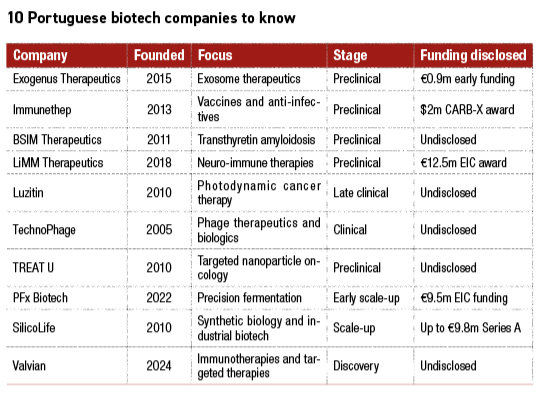
The startup pipeline itself is also maturing. In February 2025, Porto-based PFx Biotech secured €9.5 million from the European Innovation Council Accelerator to scale production of human milk proteins via precision fermentation, beginning with lactoferrin. That win matters for two reasons. First, it places a Portuguese company inside one of Europe’s most selective deep-tech funding mechanisms. Second, it shows that Portuguese biotech is not limited to classical therapeutics; it is also present in synthetic biology and next-generation food and nutrition ingredients. In March 2025, Exogenus Therapeutics, based in Cantanhede, announced a collaboration with Lonza to develop a GMP-compliant manufacturing process for Exo-101, its lead exosome-based candidate, with the company saying it expects the program to reach patients in 2027. Meanwhile, Immunethep, a University of Porto spinout, received $2 million from CARB-X in February 2025 to advance a vaccine against invasive E. coli infections. Taken together, those cases show a national sector that is diverse in modality and increasingly plugged into international industrial and funding networks.
Clinical research as an edge
The country has long argued that its national health system, concentrated hospital networks and trained investigators make it an attractive place for trials, but the bottleneck was speed and administrative predictability. The policy mood has shifted. Infarmed, the Portuguese health agency, reported that 115 clinical-trial applications were submitted in Portugal in the first half of 2025, six more than in the same period of 2024. It also said in late 2025 that average assessment times for mono-national clinical trials had fallen from 71 days in 2023 to 45 days in 2024. In March 2026, Portugal enacted Law No. 9/2026, which implements the EU clinical-trials regulation in Portuguese law and strengthens participant protections, including access to free medication after the trial in certain cases. Separately, AICIB, a Portuguese agency that supports clinical research and biomedical innovation, and a multidisciplinary working group that included Infarmed released a model financial agreement for medical-device clinical research, intended to facilitate contracting between sponsors and research centers. None of these steps guarantees a boom in trials, but together they show a system trying to remove friction from one of biotech’s most important enabling layers.
Portugal is also gaining visibility at the networking and branding level, which in biotech is not superficial. Lisbon is hosting BIO-Europe Spring for the first time from March 23 to 25, 2026, with the organizers describing it as Europe’s largest springtime biotech partnering event. Hosting a renowned conference does not create an industry, but it does signal that Portugal wants to present itself not merely as a low-cost location for outsourcing, but as a place where biotech companies can be financed, partnered and scaled.
The deeper question is whether Portugal can convert momentum into permanence. The ingredients are visible: a trained workforce, a research base, recognizable clusters, a maturing clinical-research framework and a handful of companies reaching meaningful technical milestones. Yet the old problems have not disappeared. Portuguese biotech still faces a small domestic capital pool, limited late-stage financing, and the perpetual risk that promising science will leave the country as soon as larger foreign money appears. That is why the current phase matters. Portugal is no longer trying simply to prove that biotech exists there. It is trying to prove that the country can host the full chain: science, startup formation, translational development, clinical studies, specialized manufacturing and international partnering. The answer is not settled yet but in 2026, Portugal’s biotech industry looks less like an emerging curiosity and more like a serious, if still secondary, European ecosystem that is learning how to build scale without losing focus.
This article was originally published in European Biotechnology Magazine Spring 2026.
 BIMOVIS GmbH
 SPRIND
 Rheticus/Evonik