


Selecting a CDMO for Custom Activated PEGs
This article examines the critical success factors for PEGylated therapies and the decision-making process for when a custom PEG may be warranted rather than an off-the-shelf solution. The essential role of a contract development and manufacturing organization (CDMO) with deep expertise in activated PEG chemistry is highlighted. Authors: Raymond Behrendt, Silvia Kaden-Vagt, Lotfi Bouchekioua, Merck KGaA, Darmstadt, Germany
PEGylation, the covalent attachment of polyethylene glycol (PEG) chains to active pharmaceutical ingredients (APIs), is a proven strategy for enhancing drug performance. PEGylation can significantly increase the therapeutic efficacy of various modalities, by improving solubility, stability, and circulation halflife. As of 2024, there have been 38 pegylated therapeutics approved by the FDA, including proteins, antibody fragments, oligonucleotides, small molecules, nanoparticles, and vaccines; 28 of the 38 approved PEGylated therapeutics are proteins.
From Off-the-Shelf to Custom PEGs
As drug development advances from early phases to late-stage clinical trials and commercial readiness, the requirements placed on raw materials, including functionalized PEGs, grow significantly more stringent. While off-the-shelf PEGs may be suitable for speed and flexibility in Phase 1, they often lack the process control, documentation, and regulatory rigor needed for later stages.
The key drivers that signal when it’s time to transition to a custom PEG solution are outlined below, and include the phase of development, regulatory classification, and operational requirements.
Phase-Appropriate PEGs
In early clinical development, particularly Phase 1, where speed is paramount and clinical attrition rates remain high, drug developers may choose to rely on off-the-shelf functionalized PEGs rather than investing in highly optimized or complex PEG solutions. As development progresses toward Phase 2, Phase 3, and commercial launch, the emphasis shifts to process consistency, yield reliability, and specification compliance. This is where process optimization becomes critical, ensuring that every batch meets quality standards, avoiding costly delays or rework, and eliminating the need to start from scratch during late-stage development. At this point, the off-the-shelf functionalized PEG source used in early development is likely to lack the necessary GMP compliance, documentation, or process control to satisfy regulatory agencies. This triggers the need to replace the catalog product with a custom, GMP-compliant PEG solution.
Regulatory-Driven Requirements
Another consideration in determining when to transition to a custom functionalized (activated) PEG is how the functionalized PEG will be classified in regulatory filings. Specifically whether the functionalized PEG is considered an API Regulatory Starting Material (RSM) or an API Intermediate will significantly influence the regulatory path, manufacturing requirements, and the expected level of documentation that is required.
- An RSM is generally considered to be several synthetic steps upstream of the final API and to contribute a significant structural element to the drug substance. When a functionalized PEG is designated as the RSM, its own manufacture is not subject to GMP requirements; however, subsequent stages of API synthesis are expected to comply with ICH Q7 GMP principles. The designation is typically regarded as the point from which regulatory oversight of the API synthesis commences. Regulatory agencies will expect clear justification of the RSM’s selection, a comprehensive impurity control strategy, and detailed knowledge of upstream processing steps. Since ICH Q11 outlines principles, not strict rules, for selecting RSMs, interpretations can vary across regions. Agencies such as the FDA and EMA may have differing views, so it is essential to plan conservatively to ensure global compliance.
- If a functionalized PEG is classified as an API intermediate, the regulatory requirements are substantial. In the U.S., the functionalized PEG manufacturer may submit a Type II Drug Master File (DMF), which can be cross-referenced in the sponsor’s application via a Letter of Authorization (LoA). In the EU, there is no DMF or ASMF procedure for intermediates; therefore, the sponsor must include all relevant information for the intermediate directly in the drug substance section of the dossier, supported by appropriate supplier documentation as needed. Accordingly, the decision to classify a functionalized PEG as a registered starting material or an API intermediate should be made early in development, based on a thorough regulatory and scientific evaluation and early engagement with regulatory authorities is strongly advised to determine functionalized PEG classification and guide strategy. Companies that delay these decisions may find themselves scrambling to resolve issues in late phase development. Starting with a custom functionalized PEG and GMP manufacturing partner from the beginning can avoid these pitfalls and provide regulatory confidence throughout the development lifecycle.
Technical and Operational Drivers
In addition to classification and regulatory compliance, several technical and operational drivers favor a shift to custom PEGs:
- Custom functionalization tailored to specific conjugation targets (e.g., cysteine residues or alternative amino acid side chains).
- Improved impurity control and analytical transparency, essential for regulatory filings.
- Scalability from gram-scale preclinical use to multi-kilogram commercial quantities.
- Process ownership, giving sponsors full control over the PEG used in their drug product.
Quality Control Considerations
As noted above, the identification and characterization of PEG impurities is complex and demands advanced analytical capabilities and specialized expertise. A PEG manufacturing partner must be equipped with a range of instrumentation to ensure product quality and consistency. This includes gel permeation chromatography (GPC), matrix-assisted laser desorption/ionization (MALDI), and multi-angle light scattering (MALS) for assessing molecular weight and distribution, as well as high-resolution nuclear magnetic resonance (NMR) and mass spectrometry (MS) for detailed structural characterization.
Identifying impurities often requires the synthesis of custom reference standards and the use of specialized microbiological testing laboratories. These analytical tools and methodologies are essential for confirming the size, structural integrity, and functionalization of the PEG molecule, whether it is to be conjugated to an API or incorporated as a component of a lipid nanoparticle (LNP). Analytical methods are typically customized for the specific PEG variant during the development phase and then validated for use in GMP production, where rigorous quality control is critical.
Your CDMO should leverage a variety of advanced technologies to characterize PEGs and their impurities throughout development and GMP production. Post-synthesis, purification technologies such as ion exchange chromatography (IEX) and tangential flow filtration (TFF) might be employed to achieve the high purity levels required for pharmaceutical use.
Millipore® CDMO Services
With 35+ years of proven small molecule production experience and extensive expertise in the area of custom activated PEGs, Millipore® CDMO Services has significantly contributed to the success of PEGylated therapeutics. The Small Molecule CDMO has a dedicated PEG Center of Excellence in Schaffhausen, Switzerland specialized in custom PEG production from lab-scale synthesis to pilot plant and full commercial-scale operations. For large-scale operations, Millipore® CDMO Services also has a state-of-the art facility in Darmstadt, Germany. This ensures the supply of non-GMP development samples to GMP-compliant batches, ranging from grams to multi-kilogram quantities suitable for commercial production in regulated markets. Such scalability provides flexibility and continuity as projects move from early development through clinical trials and into commercial supply.
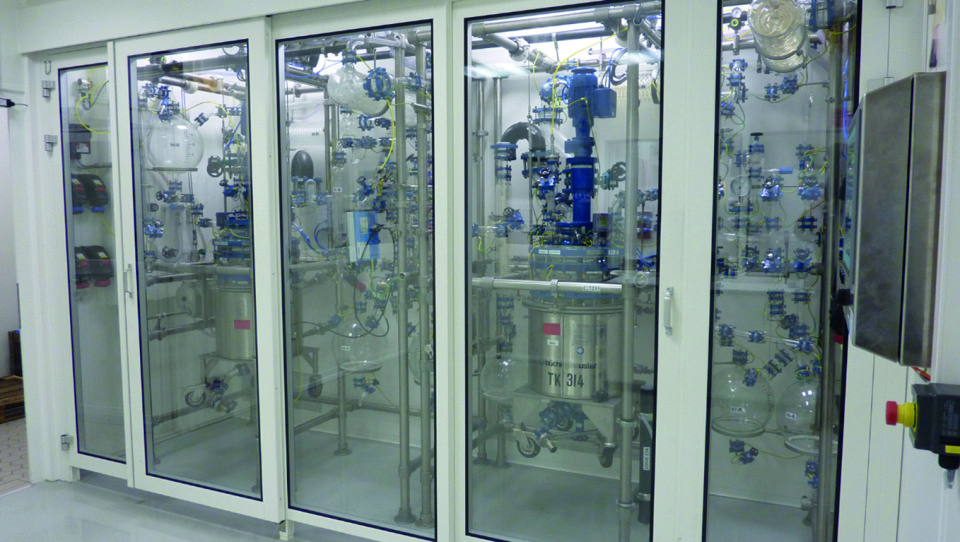
Picture below:
Kilolab in Schaffhausen, Switzerland:
Initial scale-up of polyethylene glycols (PEGs) for clinical phase I/II trials
 Moderna
 Boehringer Ingelheim
 Beiersdorf