
CSL backs Swiss Alentis’ claudin-1 bet with up to $1.6bn deal
Australian biopharma company CSL has entered an exclusive global partnership with Basel-based Alentis Therapeutics to co-develop and co-commercialize lixudebart, an investigational antibody targeting claudin-1. CSL will pay Alentis $355 million upfront and the Swiss biotech is eligible for up to another $1.2 billion in commercial milestone payments. Once the drug reaches the market, global profits will be split 55% to CSL and 45% to Alentis. What is the deal all about?
An exclusive global partnership of Basel-based Alentis Therapeutics with Australian CSL aims at co-developing and co-commercializing lixudebart, an investigational antibody targeting claudin-1. The agreement gives CSL a leading role in a clinical program that Alentis has built around its proprietary claudin-1 platform. CSL will also take on the financial burden of development, including the ongoing Phase II RENAL trial, a planned Phase III study in AAV-RPGN and additional Phase II trials in focal segmental glomerulosclerosis (FSGS) and primary sclerosing cholangitis (PSC).
Backstory: Alentis has spent several years building a therapeutic strategy around claudin-1 (CLDN1), a protein involved in tight junctions between cells. The Basel biotech was founded on research by Thomas Baumert at the University of Strasbourg and Inserm and has attracted substantial private funding. By 2025, its financing had reached around $366 million, including a Series D round of more than $180 million.
- Alentis has pursued claudin-1 in two distinct areas: fibrosis and oncology. Lixudebart is the lead fibrosis program, while ALE.P02 and ALE.P03 are claudin-1-directed antibody-drug conjugates being developed against solid tumors. ALE.P02 has received FDA Fast Track designation for advanced or metastatic claudin-1-expressing squamous cancers.
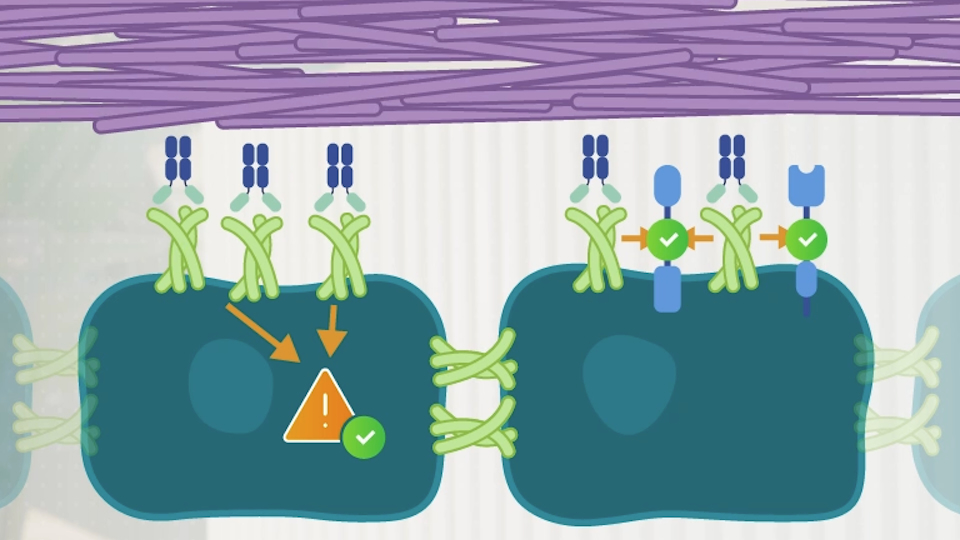
How it works: Claudin-1 is part of the molecular machinery that controls cell-cell barriers. Alentis’ approach is based on the observation that exposed claudin-1 can contribute to inflammatory and fibrotic signaling. Lixudebart is designed to selectively bind this exposed form and potentially address both inflammation and fibrosis.
- That dual mechanism is particularly relevant in diseases in which ongoing inflammation drives irreversible organ damage. In AAV-RPGN, for example, patients can lose kidney function rapidly despite existing immunosuppressive treatment. Alentis is therefore seeking not only to suppress inflammation but also to interfere with the fibrotic processes that can lead to permanent organ damage.
Zoom in: Lixudebart is currently being tested in the Phase II RENAL study in AAV-RPGN. An interim analysis of 26 patients reported improvements in eGFR and proteinuria after 24 weeks. In the Phase Ib FEGATO study, which enrolled 41 patients with advanced F3/F4 liver fibrosis, the company reported improved liver function after six weeks.
- Both studies also showed dose-dependent target engagement, with a favorable safety and tolerability profile reported by Alentis. These findings are encouraging, but they remain early clinical signals rather than proof of efficacy. The larger controlled studies will have to establish whether the biological mechanism translates into meaningful clinical benefit.
The big picture: The transaction fits CSL’s strategy of expanding its nephrology business through external innovation. CSL is taking over responsibilities for the global development and commercialization of a molecule already in Phase II, while funding the next stages of clinical development.
- The company will initially focus on AAV-RPGN, but also plans to test lixudebart in FSGS and PSC. The latter is a chronic autoimmune liver disease for which there is currently no approved treatment, giving the program a potentially broad rare-disease footprint across both kidney and liver indications.
- For Alentis, the agreement provides both validation and substantial non-dilutive funding for its lead program. The company can advance lixudebart through late-stage development without having to finance the increasingly expensive Phase III program itself.
- It also provides a global commercial partner with established development capabilities in nephrology. At the same time, Alentis retains a substantial economic interest through the 45% share of future global profits and can continue to develop its wider claudin-1 pipeline.
What’s next: The immediate focus will be the completion of the Phase II RENAL study and preparation for Phase III development in AAV-RPGN. In parallel, CSL and Alentis plan to initiate Phase II programs in FSGS and PSC.
- The partnership therefore represents a significant transition for Alentis: from a highly financed biotech built around an unconventional target to a clinical-stage company with a global pharmaceutical partner behind its lead asset. The next question is whether the clinical data can support the much broader claim behind the deal — that claudin-1 can become a therapeutically useful target across multiple fibrotic diseases.
 Lonza Group
 Nuclidium AG
 InflaRx