
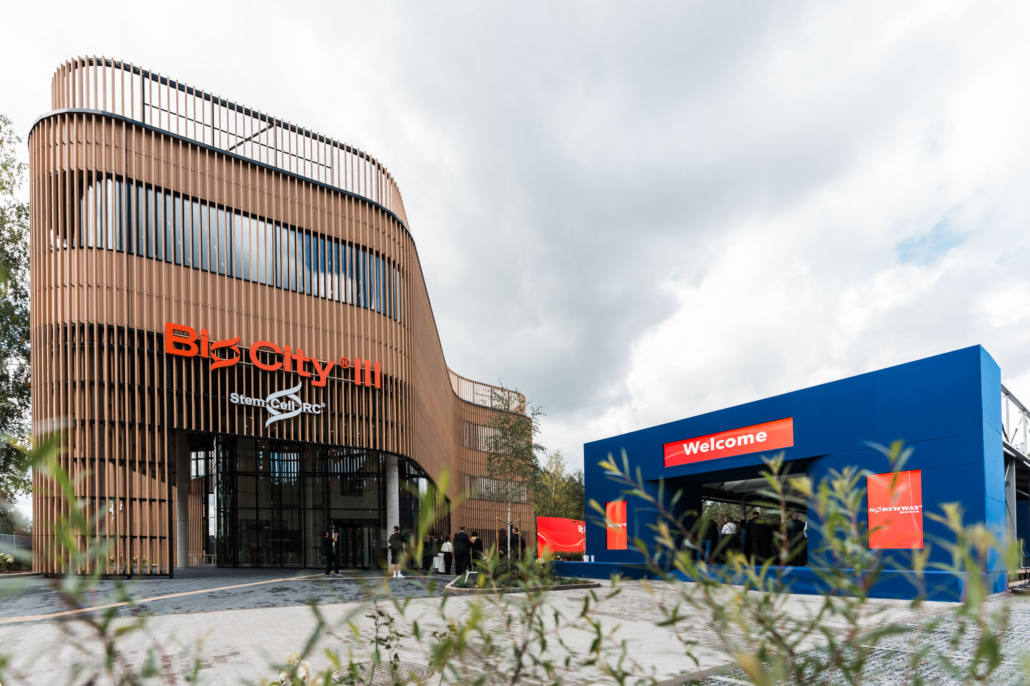
Northway opens €61M Vilnius plant built for personalized medicine
CDMO company Northway Biotech has opened a €61 million cell therapy and personalized medicine center in Vilnius that is being qualified for GMP manufacturing, and the company says it expects a manufacturing authorization from Lithuania's State Medicines Control Agency within six months.
Why it matters: Northway told European Biotechnology that it is already accepting projects (with six mammalian cell therapy lines and four microbial vaccine production lines currently undergoing qualification), and that the timing lets customers start process development now and move into GMP once the agency signs off. The project is helping usher in an entirely different pharmaceutical model in the Baltics and Europe.
What they’re saying: “We are accustomed to traditional pharmaceutical manufacturing, where a single process produces medicines for large numbers of patients,” said founder Vladas Algirdas Bumelis in the press release. “Here, in some cases, an entire manufacturing process may be dedicated to just one person.”
By the numbers: On that model there is no bigger batch to make, only more processes running side by side, which is why the 3,500 sq. m center is built as segregated lines under separate contamination control. The ten lines now in qualification sit against the “up to 20 independent cGMP manufacturing lines” the announcement advertises; Northway told EB the cleanrooms “can accommodate up to 40 suites, with expansion planned as demand increases.”
Zoom in: The other argument for Vilnius is the campus next door. In a typical outsourced CAR-T supply chain, the viral vector used to modify patients’ cells may be manufactured, tested and released by a separate provider before being supplied to the cell-therapy plant. Splitting plasmid, vector and cell manufacturing across suppliers creates additional handoffs, shipments and quality interfaces, while the sponsor retains responsibility for oversight of the whole chain.
- Northway’s gene therapy center, Celltechna, has made vectors and plasmids one site over in BIO CITY II since 2024. “In global pharmaceuticals, one of the biggest issues today is a complex supply chain and a lengthy waiting process for genetic material,” Bumelis said when the project was announced in June. Co-location removes one of those handoffs — the logic now driving consolidation among European CDMOs.
Follow the money: ILTE, Lithuania’s national development bank, lent €48 million of the €61 million under its Milijardas verslui program, with Northway funding the rest. The center is expected to employ about 100 people and is pitched as a step toward Lithuania’s target of life sciences reaching 5% of GDP by 2030.
Yes, but: Rentschler Biopharma read the same market and left. In January 2025, the German CDMO withdrew from cell and gene therapy and closed its Stevenage site, which made viral vectors — the capability Northway’s new plant is built to draw on. “The cell and gene therapy market has experienced slower-than-expected growth, with demand across the industry not meeting our expectations,” CEO Benedikt von Braunmühl said at the time.
Bottom line: Northway is betting that CAR-T manufacturing moves out of university hospitals, which make it in small quantities for their own patients, and into contract facilities at industrial scale. The test is how many of the company’s development projects convert to GMP work once the authorization lands, and whether the suites fill fast enough to service €48 million of borrowing.
 Lonza Group
 Samsung Biologics